Managing Mild Psoriasis: A Holistic Guide to Clearer Skin in 2026

What if the tiny patches of dry skin you've been hiding are actually a signal that your body is seeking internal equilibrium? While clinical guidelines define mild psoriasis as affecting less than 3 per cent of your body, roughly the size of three palms, the persistent itching and silver flaking can feel like a much heavier burden. It's exhausting to deal with the self-consciousness of visible plaques or the constant confusion of conflicting skincare advice. You've likely spent years trying to mask the surface, only to find the symptoms returning just as you start to feel comfortable.
We understand that even a small flare-up is never just "mild" when it impacts your daily life and sense of self. This guide moves beyond temporary fixes to help you achieve a state of lasting skin health through a professional, integrative management plan. You'll discover how to identify your unique internal triggers and reduce the frequency of flare-ups with a clear, personalised strategy for 2026. By exploring the latest topical treatments and systemic balance, we'll map out a restorative path that treats your skin as the vital, living organ it is.
Key Takeaways
- Learn how to identify the subtle signs of mild psoriasis beyond surface area measurements and understand why early intervention is vital for long-term comfort.
- Discover the connection between your internal health and external flares by exploring the "Gut-Skin Axis" and its role in maintaining clear skin.
- Access a structured daily routine that prioritises barrier repair and deep hydration to soothe persistent itching and flaking.
- Recognise when to transition from temporary home remedies to a professional management plan designed to address the root causes of your symptoms.
- Explore the convenience of personalised online consults that provide expert dermatological guidance from the comfort of your own home.
Understanding Mild Psoriasis: More Than Just a Surface Concern
When you hear the word "mild," it suggests something manageable or perhaps even trivial. However, for those living with mild psoriasis, the experience is rarely that simple. This condition is not just a cosmetic nuisance; it is a visible manifestation of your body’s internal immune dialogue. While the surface might show silvery scales or red plaques, the root of the issue lies deeper within your systemic health. Recognising this connection is the first step toward moving from a state of frustration to one of restorative care.
For those seeking a comprehensive overview of psoriasis, it is helpful to understand that it is a chronic autoimmune condition where skin cells regenerate at an accelerated rate. This process creates the characteristic build-up of cells that we see as plaques. Even if these patches are small, they indicate that your immune system is in a state of high alert. Understanding your skin as a mirror of your internal health allows you to approach management with both clinical precision and nurturing patience.
The Clinical Definition of "Mild"
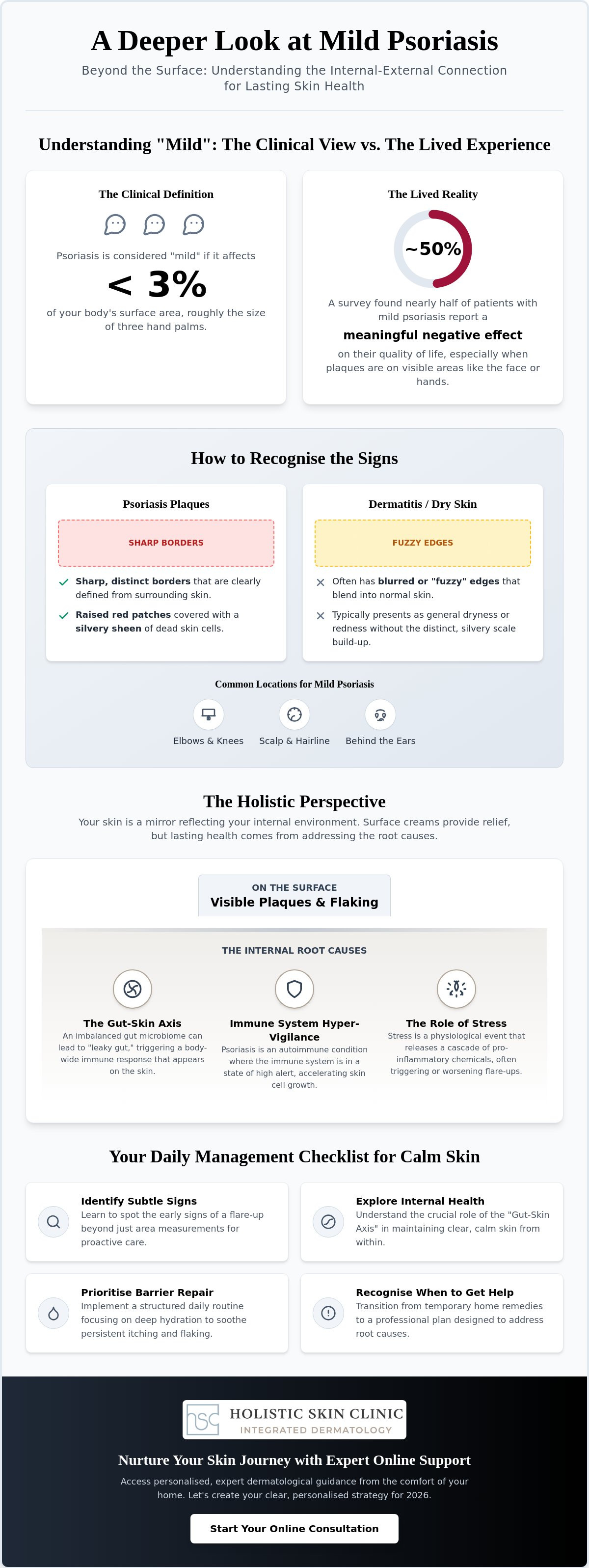
In a clinical setting, dermatologists often use the Psoriasis Area and Severity Index (PASI) to categorise the condition. Generally, mild psoriasis is defined as affecting less than 3 per cent of the body's surface area. To put this in perspective, the palm of your hand represents roughly 1 per cent. If your plaques cover less than three "palms" of skin, it falls into the mild category. However, these numbers don't tell the whole story. A National Psoriasis Foundation survey conducted between 2019 and 2021 found that nearly half of patients with mild disease reported a meaningful negative effect on their quality of life. If a plaque is on your face, hands, or scalp, its impact on your confidence is far greater than its physical measurement suggests. Early identification is essential to prevent these small patches from progressing into more extensive concerns.
Common Physical Presentations
Mild cases often present as small-plaque psoriasis, characterised by well-defined, raised red patches covered with a silvery sheen of dead skin cells. Another common form is guttate psoriasis, which appears as small, drop-like lesions across the torso or limbs. These plaques typically settle on the elbows and knees, though they frequently hide within the hairline or behind the ears. It is easy to mistake these patches for simple dry skin or nummular dermatitis. The key difference lies in the edges; psoriasis plaques usually have very sharp, distinct borders, whereas dermatitis often has a more blurred or "fuzzy" appearance. Identifying these nuances early helps you organise a more effective management plan before the condition progresses. By distinguishing these patterns, you can move toward a state of balance and skin clarity.
The Holistic Perspective: Why Surface Creams Aren’t the Full Answer
If you have ever felt that your creams are merely "chasing" the plaques around your body, you aren't alone. Managing mild psoriasis often feels like a game of whack-a-mole because traditional approaches focus almost entirely on the surface. While high-quality topicals are essential for immediate relief, your skin acts as a sophisticated mirror, reflecting the subtle shifts happening within your internal environment. True skin health isn't just about what you apply. It's about understanding why your immune system is in a state of hyper-vigilance.
A clinical overview of psoriasis management suggests that while topicals remain the standard first-line response, the condition is fundamentally systemic. This research highlights that managing the internal environment is just as crucial as addressing the visible plaques. When you look at the body as an interconnected whole, it becomes clear that surface-level solutions are only one piece of the puzzle. The nervous system also plays a starring role. Stress isn't just a feeling; it's a physiological event that can trigger a cascade of pro-inflammatory chemicals. When your system is under pressure, your skin often bears the brunt.
The Role of Gut Health in Skin Calm
Your gut is home to a vast ecosystem known as the microbiome, which serves as the primary training ground for your immune system. When this ecosystem is out of balance, it can lead to increased intestinal permeability, often referred to as "leaky gut." This allows particles to enter the bloodstream that shouldn't be there, setting off an immune alarm. This systemic "red alert" often manifests on the surface as mild psoriasis. A truly comprehensive psoriasis management plan must consider these internal signals to achieve lasting results. Moving toward a state of balance requires a shift from simply suppressing a flare-up to nurturing your body's natural equilibrium.
Inflammation: The Hidden Driver
Think of systemic inflammation as a low-grade fire burning beneath the surface. In psoriasis, this "heat" accelerates skin cell turnover, causing cells that usually take a month to mature to reach the surface in just a few days. This rapid progression creates the silvery scales and red plaques you see. Instead of just trying to "put out the fire" on the skin, a holistic approach aims to "cool the system." By addressing these hidden drivers, you move beyond temporary fixes toward a transformative path of personal confidence and vitality. It's a journey of discovery that looks beyond the symptoms to find a state of true health.
Your Daily Management Checklist for Calm Skin
Managing mild psoriasis requires a shift from reactive treatment to proactive, daily care. It’s about creating a rhythm that supports your skin’s natural barrier while minimising external disruptions. This checklist provides a structured path to help you maintain equilibrium and reduce the frequency of flare-ups. When you organise your day around these supportive habits, you move closer to a state of lasting skin clarity and personal confidence.
Consistency is your most powerful tool. Small, intentional actions taken every morning and evening build a foundation of resilience, allowing your skin to heal rather than just survive. By focusing on both the external barrier and your environmental surroundings, you create a 360-degree shield against the triggers that often lead to physical distress.
The Skincare Pillar: Protecting the Barrier
The foundation of any management plan is a strong, resilient skin barrier. Standard soaps often contain harsh surfactants that strip away essential lipids, leaving your skin vulnerable to irritation. Switching to soap-free cleansers is a simple yet transformative step. These formulations cleanse without disrupting the delicate pH of your skin, ensuring that your natural oils remain intact.
One of the most effective habits you can adopt is the "Three-Minute Rule." After bathing or showering, pat your skin dry gently with a soft towel and apply your emollients within three minutes. This specific window allows you to lock in the moisture from the water before it evaporates into the air. You should also be vigilant about identifying common irritants. Synthetic fragrances, certain alcohols, and preservatives in standard skincare can trigger inflammation in even the smallest plaques. Choosing minimalist, professional-grade formulations ensures your skin receives only the nutrients it needs to thrive.
Lifestyle and Environmental Adjustments
In New Zealand, our unique environment presents specific challenges for skin health. The intense UV levels in the Southern Hemisphere require a careful balance. While small amounts of sun exposure can boost Vitamin D and help calm mild psoriasis, a sunburn will almost certainly trigger a Koebner response, where new plaques form at the site of skin injury. Aim for short, controlled periods of exposure during lower UV times, and always protect healthy skin.
Your clothing choices also play a silent role in your comfort. Natural fibres like cotton, linen, and silk allow your skin to breathe and stay cool. Synthetic fabrics can trap heat and sweat, which often leads to increased itching and discomfort. When it comes to your internal environment, focus on foods that support equilibrium. Incorporating omega-3 fatty acids from oily fish or flaxseeds helps "cool" the system from the inside out. Finally, integrate simple stress-reduction techniques, such as mindful breathing or a brief daily walk, to soothe your nervous system and keep flare-ups at bay.
Professional Management vs. Home Remedies: Choosing the Right Path
Many New Zealanders living with mild psoriasis find themselves caught in a frustrating middle ground. You might feel your condition isn't "severe enough" for a public hospital dermatology referral, yet your GP’s standard prescriptions aren't providing the lasting relief you seek. This is exactly where professional, integrative management makes the most difference. If your skin is impacting your daily comfort or your sense of self, it's significant enough for an expert eye. There's a profound difference between a temporary treatment and a comprehensive management plan. While a treatment might clear a plaque for a week, a management plan seeks to stabilise your system for the long term.
Relying solely on home remedies or over-the-counter steroid creams carries hidden risks. Without professional oversight, frequent use of potent steroids can lead to skin thinning or "rebound" flares that are often more difficult to manage than the original patch. A specialist assessment does more than just provide a prescription; it identifies triggers and patterns you might miss alone. By looking at the whole picture, an expert can help you move from a state of physical distress toward a state of lasting balance and confidence.
When to Seek Specialist Advice
If you find that your plaques return the moment you stop using a cream, you're likely masking the symptoms rather than managing the condition. An expert assessment provides the clarity needed to distinguish between different presentations, such as small-plaque or guttate psoriasis, which may require different approaches. This professional beginning is about discovery. It's an opportunity to understand the unique language of your skin and organise a clear, well-defined map for your improvement. Recognising these signs early prevents the emotional weight of a "mild" condition from becoming a heavy burden.
The Power of Personalised Care
Chronic skin conditions don't follow a "one size fits all" rule. What works for someone else might be ineffective or even irritating for your specific skin type. A personalised management plan evolves as your skin’s needs change with the seasons or your lifestyle. It bridges the gap between clinical evidence and your daily reality, providing a structured path that feels safe and organised. Taking the first step toward a structured psoriasis management plan ensures you're no longer guessing which remedy might work, allowing you to focus on your path toward vitality.
Nurturing Your Skin Journey with Expert Online Support
Finding the right support for mild psoriasis shouldn't be a source of stress in itself. At Holistic Skin Clinic, we've pioneered a virtual approach to dermatological care that prioritises your comfort and total well-being. We believe that professional guidance should be accessible to everyone across New Zealand, regardless of whether you live in a bustling city centre or a quiet rural township. Our online model allows us to look beyond surface-level symptoms, helping you find the deeper causes of your skin concerns through a methodical and intentional process.
This isn't just a one-off appointment; it's the beginning of a collaborative partnership. We act as a steady, knowledgeable hand, leading you from a state of physical distress toward a state of lasting balance. By integrating clinical expertise with a nurturing, human touch, we ensure that your path toward clearer skin is both scientifically sound and emotionally supportive. You don't have to navigate the complexities of chronic skin conditions alone when expert guidance is just a video call away.
The Benefits of a Virtual Skin Assessment
Accessing specialist care from the comfort of your own home removes the logistical hurdles that often delay treatment. You can skip the stress of long-distance travel and the frustration of hospital waiting rooms, allowing you to focus entirely on your recovery. During your session, we utilise high-resolution digital reviews to monitor your plaques with clinical precision. These clear, detailed images allow us to track your progress over time, ensuring your management plan remains effective as your skin begins its restorative journey. This virtual environment creates a sense of safety and organisation, making it easier to discuss your concerns openly and honestly.
Your Personalised Management Plan
Following your assessment, you'll receive a structured management plan tailored specifically to your skin's unique dialogue. This isn't a generic list of instructions; it's a 360-degree strategy that includes evidence-based clinical treatments alongside practical lifestyle guidance. We focus on achieving long-term remission by addressing internal triggers, such as gut health and stress, alongside your external skincare routine. Our goal is to empower you with the tools needed for sustained skin health and renewed personal confidence. When you're ready to transition from masking symptoms to achieving true equilibrium, we invite you to organise your online skin consultation with Holistic Skin Clinic. Together, we can map out a clear, transformative path toward the vitality you deserve.
Begin Your Journey Toward Lasting Skin Clarity
Managing mild psoriasis is a journey of discovery that looks beyond the surface to find a state of true health. You've learned that your skin acts as a vital mirror of your internal environment, and that a structured daily routine is the foundation of resilience. By addressing the gut-skin axis and prioritising barrier repair, you move closer to a life where your skin no longer dictates your confidence or comfort. This shift from simply masking symptoms to nurturing your body's natural equilibrium is the key to long-term remission.
True transformation happens when you transition from guessing with home remedies to following a professional, integrative plan. We provide specialist online assessments and evidence-based holistic management plans designed to offer compassionate care for chronic conditions. This methodical approach ensures you have a clear, well-defined map for your improvement, all from the comfort of your own home. It's time to move toward a state of balance and vitality with a partner who understands the complex science of your skin.
Book Your Personalised Psoriasis Management Consultation today to start your restorative path. Your skin has a remarkable capacity for healing when given the right professional support.
Frequently Asked Questions
Can mild psoriasis ever fully disappear?
Psoriasis is a chronic condition, so while there isn't a permanent "cure" that makes it vanish forever, long-term remission is absolutely achievable. With a structured management plan, many people enjoy clear skin for months or even years at a time. The goal is to move from reactive treatment to a state of sustained balance where symptoms are no longer part of your daily reality. Consistency with your routine is the key to keeping the skin calm and resilient.
Is mild psoriasis contagious to family members?
No, psoriasis is not contagious and cannot be spread through physical contact, sharing towels, or swimming in the same pool. It is an autoimmune condition driven by internal systemic factors rather than bacteria or viruses. While it can run in families due to genetic predispositions, you cannot "catch" it from another person. Understanding this helps remove the social stigma often associated with visible plaques and encourages more open conversations about skin health.
How much does an online skin consultation cost in New Zealand?
Pricing for private dermatological services in New Zealand varies depending on the provider and the depth of the assessment. While we don't list specific fees here, you can check our current rates and availability directly on our booking page. Investing in a specialist consultation often saves you money in the long run by avoiding the cost of ineffective over-the-counter products that don't address your specific needs. It's a structured step toward a more effective management path.
Can my diet really affect my mild psoriasis flare-ups?
Yes, your diet plays a significant role in managing systemic inflammation, which is the engine behind mild psoriasis. Certain foods, such as those high in omega-3 fatty acids, can help cool the system, while highly processed sugars may trigger the immune system's alarm state. A holistic approach considers these internal factors alongside topical care to help you achieve a more predictable and calm skin state. Small, intentional changes to what you eat can lead to visible improvements on the surface.
Is it safe to use steroid creams on mild psoriasis long-term?
Long-term, unsupervised use of potent steroid creams can lead to skin thinning or a rebound effect where symptoms return more aggressively. These treatments are best used as short-term tools to settle a flare-up while you work on a broader, more sustainable management plan. A specialist can help you transition to non-steroidal alternatives and barrier-repair strategies that are safer for sustained, daily use. This approach ensures your skin remains healthy and strong without becoming dependent on strong medications.
What is the difference between psoriasis and eczema?
Psoriasis and eczema are both inflammatory skin conditions, but they have distinct characteristics and causes. Psoriasis plaques are typically well-defined with silvery scales, often appearing on the elbows, knees, or scalp. Eczema usually presents as a more fuzzy or poorly defined red rash that is intensely itchy and often settles in the creases of the arms or legs. A professional assessment is the only way to ensure an accurate diagnosis and an effective treatment strategy.
How do I prepare for a virtual skin assessment?
Preparing for your online consult is simple and stress-free. Ensure you are in a well-lit room, ideally with natural light, and have a list of any current medications or skincare products you are using. Taking a few clear, high-resolution photos of your plaques beforehand can also be incredibly helpful for your clinician to review during the session. This preparation helps us create a more precise and personalised management plan that fits your lifestyle and skin needs.
Can stress cause my psoriasis to spread?
Stress is a well-documented trigger that can increase the intensity and spread of mild psoriasis. When your nervous system is under pressure, it releases chemicals that can accelerate skin cell turnover and heighten systemic inflammation. Integrating mindfulness or relaxation techniques into your daily routine is a vital part of cooling your system and maintaining long-term skin health. Managing your internal calm is just as important as the creams you apply to your plaques.